
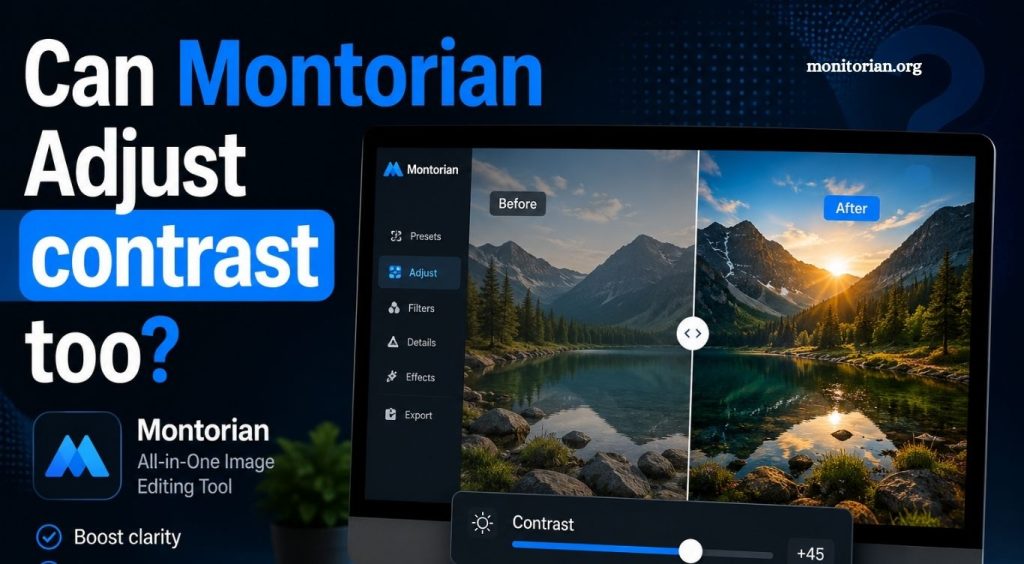
When choosing a monitor or display solution, users often focus on brightness, resolution, color accuracy, and screen size. However, contrast plays an equally important role in overall image quality. This raises a common question: Can Montorian adjust contrast too?
The simple answer depends on the Montorian version, device compatibility, and available display controls. In many cases, contrast adjustments work alongside brightness and other visual settings, helping users achieve clearer, more comfortable screen output.
What Does Contrast Adjustment Mean?
Contrast adjustment controls the difference between bright and dark areas on a screen. Higher contrast can make whites appear brighter and dark shades look deeper. Lower contrast creates a softer visual appearance.
Read More: Can Montorian control multiple monitors at once?
Proper contrast settings improve text visibility, image details, and overall viewing comfort. Poor contrast may cause faded visuals or hide details in darker areas. For users working long hours on screens, balanced contrast can also create a more pleasant viewing experience.
Can Montorian Adjust Contrast Too?
Yes, Montorian may support contrast adjustment when the connected display and system provide compatible controls. The exact functionality can vary based on hardware, operating system, drivers, and Montorian features.
Some displays allow software-based contrast management, while others require users to change contrast through physical monitor buttons or an on-screen display menu.
If Montorian detects supported display controls, users may gain easier access to visual adjustments without repeatedly opening monitor menus.
How Does Contrast Adjustment Improve Display Quality?
Contrast has a major impact on how content appears on a screen. A properly adjusted contrast level can deliver sharper text, clearer images, and improved separation between light and dark elements.
For example, dark scenes in videos may lose important details when contrast levels are too high. On the other hand, low contrast can make the entire screen appear washed out. A balanced setting provides natural visuals without excessive brightness or overly dark shadows.
Contrast vs. Brightness: What Is the Difference?
Brightness and contrast serve different purposes, although users often confuse them. Brightness mainly controls the overall light output of a display. Increasing brightness makes the entire screen appear lighter. Contrast controls the difference between bright and dark screen areas.
Adjusting brightness alone may not solve faded colors or weak image depth. Contrast adjustment can help create stronger visual separation and improve content clarity. For better results, users should balance both settings rather than relying on a single display control.
How to Check If Montorian Supports Contrast Adjustment
Users can review Montorian’s available controls and look for a contrast option within display settings. If contrast control appears, the connected monitor likely supports the required adjustment method.
It is also helpful to check monitor specifications and display driver compatibility. Updated drivers may improve communication between software and monitor hardware.
When no contrast option appears, users can access the monitor’s built-in menu. Most modern monitors include manual contrast controls within the picture or display settings.
Best Contrast Settings for Comfortable Viewing
There is no single contrast level suitable for every user. Room lighting, monitor type, screen content, and personal preferences can affect the ideal setting.
Start with the monitor’s default contrast level. Make small adjustments while viewing text, images, and dark content. Avoid extreme settings that remove details from bright or dark areas.
For office work, a balanced contrast level helps maintain readable text. Creative professionals may require carefully calibrated settings for accurate image and video work.
Does Contrast Adjustment Help Reduce Eye Strain?
Balanced display settings may improve visual comfort during extended screen use. Excessively bright whites and deep dark areas can create an uncomfortable viewing experience, especially in low-light environments.
Adjusting contrast alongside brightness can create a smoother visual balance. However, screen distance, room lighting, font size, and regular breaks also influence viewing comfort.
Users should select settings that provide clear content without forcing the eyes to constantly adapt to extreme light differences.
Common Problems With Contrast Adjustment
Sometimes, contrast controls may appear unavailable or fail to produce noticeable changes. Hardware limitations are a common reason. Certain monitors do not accept software-based contrast commands.
Outdated graphics drivers can also affect display controls. Updating display drivers and restarting the system may solve compatibility issues.
Users should also check whether HDR or another automatic picture mode is active. Some display modes manage contrast automatically and may limit manual adjustments.
Is Montorian Contrast Control Worth Using?
If Montorian supports contrast adjustment with your display, the feature can provide a convenient way to manage screen appearance. Easy software controls reduce dependence on physical monitor buttons and complicated on-screen menus.
Contrast adjustment becomes particularly useful for users who frequently switch between office work, entertainment, creative tasks, and nighttime viewing.
The ability to quickly modify display settings can create a more personalized and comfortable screen experience.
Conclusion
Montorian can help adjust contrast when supported by the monitor and system. Proper contrast settings improve screen clarity, text readability, and visual balance. Checking display compatibility and available controls ensures better results, creating a clearer, sharper, and more comfortable viewing experience.